Neocloud Stocks Lose Up to 40% in a Month as A.I. Doubts Grow


Set Trending Topics as a preferred source on Google.
From A.I. darlings to problem children in four weeks: Shares of the so-called neoclouds, the specialized providers that rent out computing power for A.I. models, have collapsed on the stock market. In the space of a month, from early October to early November, they lost between 26 and 40 percent of their value.
Here are the losses since early October:
- WhiteFiber: down 39.8 percent
- CoreWeave: down 39.2 percent
- IREN: down 39.0 percent
- HIVE Digital: down 38.3 percent
- Nebius: down 36.1 percent
- ChronoScale: down 29.7 percent
- Hut 8: down 25.9 percent
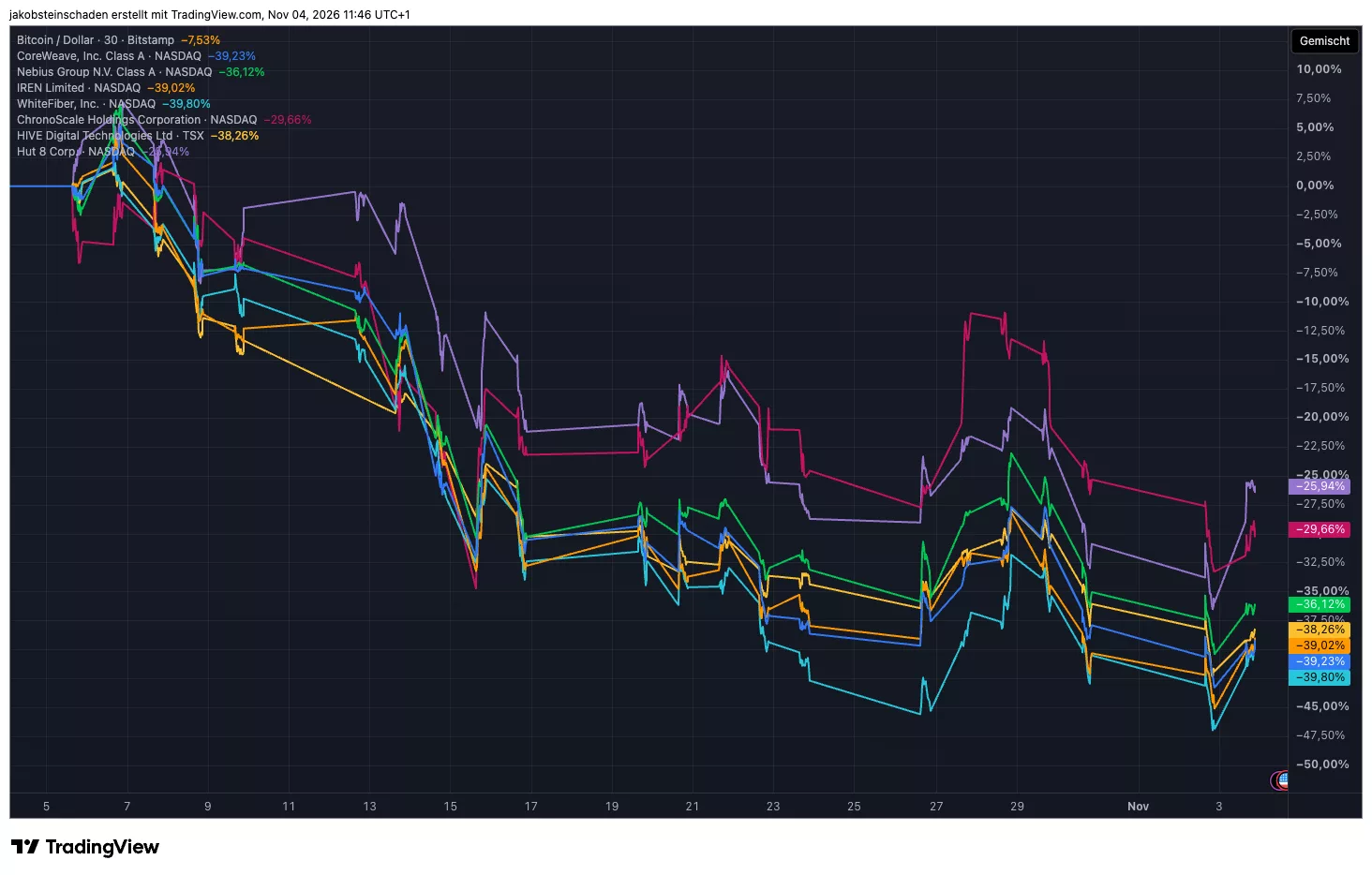
By comparison, Bitcoin, to which many of these companies are still tied as former crypto miners, lost 7.5 percent over the same period.
The Broader Market Fell Far Less
The broader tech market also had a weak October, but nowhere near as bad. The Nasdaq Composite fell 5.3 percent in October, its worst month since March 2025. The Nasdaq 100 lost about 6.7 percent. The S&P 500 ended the month almost flat, down 0.9 percent, and the Dow Jones Industrial Average even rose. Besides the neoclouds, chipmakers were hit hardest: The PHLX Semiconductor Index fell 15.4 percent.
That means the neoclouds lost far more than the chip sector and five to seven times as much as the Nasdaq Composite.
Why the Stocks Crashed
The sell-off was driven by a mix of debt, doubts about the billions being spent on A.I. and high-profile warnings:
- Mountains of debt: Neoclouds largely finance their data centers with borrowed money. CoreWeave alone carries $51.6 billion (about €46 billion) in debt, including lease obligations, or $46 billion net of cash. After the crash, its stock market value has shrunk to about $30 billion (about €27 billion), meaning its debt is roughly 1.7 times the size of its entire market capitalization. The yield on a CoreWeave bond due in 2031 recently climbed to a record of almost 16 percent, meaning investors are demanding a hefty risk premium. Hotter-than-expected inflation data added to fears of higher interest rates.
- Gartner’s warning: In mid-October, the research firm Gartner predicted that more than 80 percent of neoclouds would no longer operate independently by 2030. CoreWeave fell more than 15 percent that day.
- Musk’s prophecy: Shortly afterward, Elon Musk predicted a “guppy-level death” for the roughly 200 neoclouds, saying only a few would survive.
- Big Tech eases off: In late October, Microsoft’s capital spending came in below expectations, sending neocloud stocks down again, according to CNBC. Shortly after, Alphabet, Intel and Amazon triggered a broad tech sell-off as investors increasingly questioned whether the billions spent on A.I. infrastructure will pay off.
- Crypto weakness: Many neoclouds, such as IREN, HIVE and Hut 8, started out as Bitcoin miners and still earn part of their money from crypto. The drop in Bitcoin, partly after the record hack at Binance, added to the pressure.
“Compute demand can grow exponentially, but the capital available to finance it cannot,” Rich Privorotsky, a strategist at Goldman Sachs, said, summing up the problem.
Nscale’s I.P.O. Under Pressure
The crash comes at a bad time for Nscale. The British A.I. infrastructure company filed its I.P.O. prospectus with the S.E.C. in September and plans to list on the New York Stock Exchange under the ticker NSCL. According to reports, Nscale is targeting a valuation of $30 billion to $35 billion (about €27 billion to €31 billion), wants to raise up to $3 billion and aims to go public before the end of the year.
Even before the latest slump, however, there was resistance. According to Bloomberg, some investors want to pay only $16 billion to $19 billion. On top of that, Microsoft has abandoned a planned Nscale site in Britain, according to The Telegraph. Microsoft and Anthropic together account for about 85 percent of Nscale’s contract value. With listed rivals like CoreWeave and Nebius losing more than a third of their value in a month, it is likely to be hard for Nscale to achieve its target valuation. It may have to lower the price or postpone the listing.
Hopes for Takeovers
Not everyone is gloomy. John Lovelock, Gartner’s chief forecaster, expects many neoclouds to be absorbed by larger providers through takeovers and mergers and does not foresee a mass die-off. Michael Intrator, CoreWeave’s chief executive, reportedly told staff in an internal memo that the market was acting irrationally. And demand for computing power remains strong: Nscale, for example, has signed contracts worth up to $43.8 billion with Microsoft and up to $44.6 billion with Anthropic, and it is reportedly already negotiating a second deal with Anthropic worth $45 billion.