Geely Buys Into Nio: 30 Percent of the Battery Swap Network at a $2.4 Billion Valuation


Set Trending Topics as a preferred source on Google.
Nio has sunk billions into battery swap stations for years. Now, of all companies, rival Geely is buying in. The Chinese auto group is taking a 30 percent stake in Nio Power, the EV maker’s charging and battery swapping unit, Nio says in a news release. The unit is valued at about 16 billion yuan (roughly 1.9 billion euros or $2.4 billion) in the deal. For Nio, which has posted losses for years, it is the biggest capital injection yet for its most expensive differentiator.
Cash Plus a Subsidiary
Geely is paying with more than money. The group, which also owns Volvo, Polestar and Lotus, is contributing its Chongqing-based subsidiary Yiyi Internet Technology, which runs battery swapping for commercial fleets such as taxis, and adding 640 million yuan (about 77 million euros) in cash. The key terms:
- Stake: After closing, Geely holds 30 percent of Nio Power, Nio China 63.6 percent, and an existing investor 6.4 percent.
- Performance clause: If the business misses operational milestones, Geely’s stake can fall to a floor of 20 percent.
- Option: Within two years, Geely can invest another 640 million yuan to raise its stake to 34 percent.
- Reciprocal deal: Nio China receives 10 percent of Geely’s charging unit Haohan Energy, which in turn takes over charging infrastructure from Nio.
Both transactions remain subject to regulatory approval.
The Network Nobody Wanted to Replicate
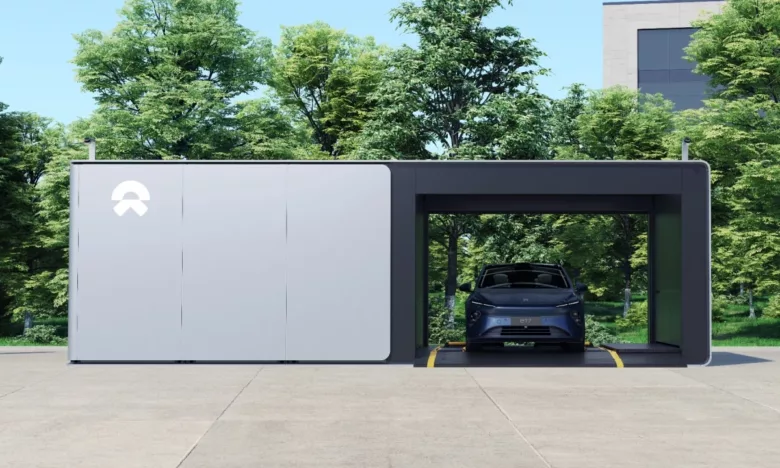
Nio operates about 4,000 swap stations in China by its own count, where a depleted battery is exchanged for a full one in a matter of minutes. At least 1,000 more are to be added this year, according to CnEVPost, and the company aims for 10,000 stations by 2030. There are also a few dozen stations in Europe, including in Germany, the Netherlands and Norway.
The catch: such a network is extremely capital-intensive, and it only pays off if enough cars use it. Geely and Nio had already agreed on a cooperation for shared battery standards in late 2023; now that turns into an equity stake. Geely plans to offer both passenger cars and commercial vehicles with swappable batteries that can dock at Nio’s stations. For Nio, that means higher utilization; for Geely, access to infrastructure that would have taken years to build.
CATL and BYD Are Taking Different Routes
Nio is no longer alone in battery swapping. Battery giant CATL is building its own “Choco-Swap” network and has signed up partners such as Changan and Sinopec. BYD is betting on the opposite approach, aiming to make swapping obsolete with charging at up to 1,500 kilowatts, as we recently reported. Ironically, Geely itself is also working on fast-charging technology with A.I.-controlled charging stations.
Geely is thus running a two-track strategy: fast charging for its own brands, battery swapping through its stake in Nio. Whether the bet pays off depends on whether Chinese car buyers keep preferring a swap over a charge once charging takes only five minutes.