Claude
Anthropic’s Fable 5.2 Knocks Gemini Off the A.I. Throne


Set Trending Topics as a preferred source on Google.
An operating system in eight days, Fermat’s Last Theorem in 30 hours and two open problems in the physics of black holes: Those are the claims Anthropic made as it unveiled Claude Fable 5.2 and Claude Mythos 5.2, its most powerful A.I. models to date. Both are faster and cheaper than their predecessors. At the same time, Anthropic acknowledges that the models notice they are being tested more often than any model before them.One Model, Two Doors
Fable and Mythos are the same model with different safeguards, according to Anthropic. Fable 5.2 is open to everyone: in the Claude apps, in Claude Code, through the A.P.I. (model ID claude-fable-5-2) and through Amazon Web Services, Google Cloud and Microsoft Azure. On Pro and standard Team plans, Fable can account for up to 50 percent of weekly usage limits. Fable does, however, block most cybersecurity and biology tasks, such as penetration testing, exploit development and large parts of biological research. Anthropic routes those requests to older Opus models. Compared with Fable 5.1, the company says there are about 55 percent fewer unnecessary blocks. Mythos 5.2 comes without those restrictions and is therefore reserved for vetted organizations. Security companies can apply through the Cyber Verification Program, and life sciences researchers through a separate verification program. Enterprise customers also get indirect access to Mythos 5.2 through Claude Security, a service that scans codebases for vulnerabilities. Prices are falling by 20 percent. There is also an optional fast mode that generates responses up to 2.5 times faster but costs twice as much:| Model | Input (per million tokens) | Output (per million tokens) |
|---|---|---|
| Fable 5.2 / Mythos 5.2 | €7.19 | €35.94 |
| Fable 5.2 / Mythos 5.2 (fast mode) | €14.38 | €71.88 |
| Fable 5.1 / Mythos 5.1 (previous) | €8.98 | €44.92 |
| Claude Opus 5.5 | €3.59 | €17.97 |
| GPT-6 Astra (OpenAI) | €8.98 | €44.92 |
Where the Models Shine
Independent testing puts Fable 5.2 firmly in the lead as well: On the Intelligence Index from Artificial Analysis, the model scores 65 points at maximum effort, taking first place well ahead of Google’s Gemini 4 Carbon at 60 points. Claude Opus 5.5 follows with 59 and OpenAI’s GPT-6 Astra with 57. The top spot comes at a price, though: Running a single index task with Fable 5.2 costs about €23.85, more than twice as much as with Opus 5.5 (about €9) and more than three times as much as with Gemini 4 Carbon (about €7). No other model in the ranking is as expensive.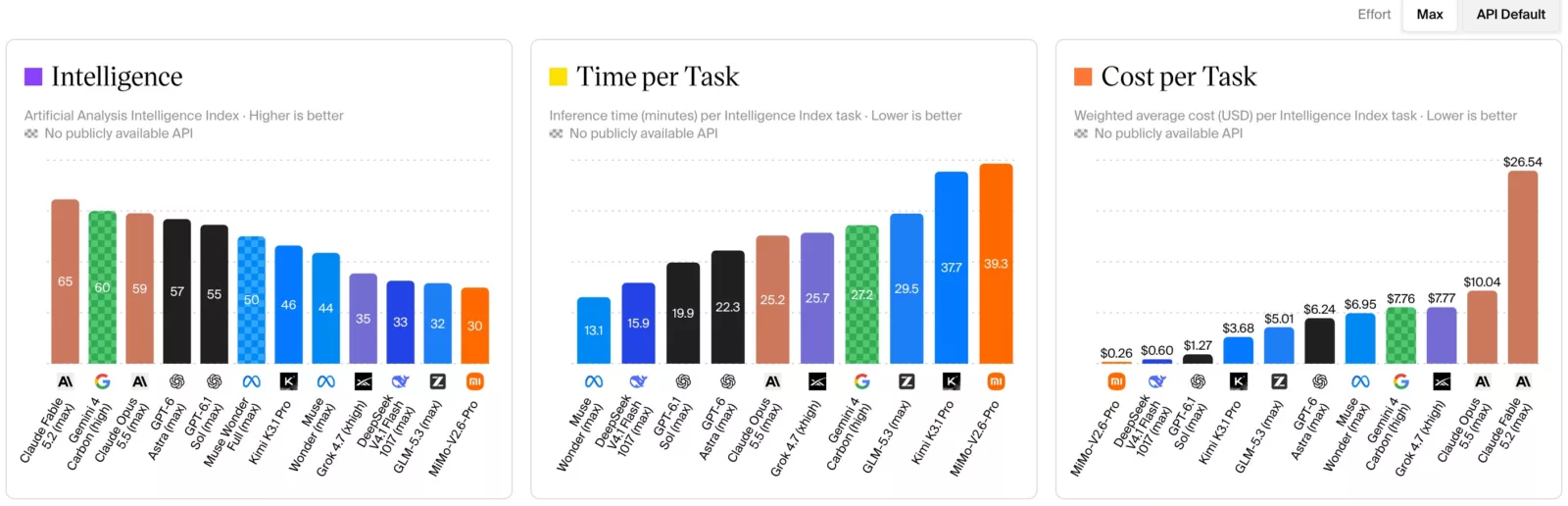
- Coding: On FrontierCode 2.0, which tests whether open-source maintainers would merge a model’s code, Fable 5.2 scores 49.1 percent, the highest of any released model. A swarm of more than 1,000 subagents wrote a bootable operating system, complete with drivers, a login screen and an installer, in eight days.
- Remote work: On the Remote Labor Index, which simulates real freelance jobs, Fable 5.2 reaches 41.3 percent. Opus 5.5 manages 21.3 percent and GPT-6 Astra 20.8 percent.
- Robotics: Controlling a simulated two-armed robot (RoboDojo), Fable 5.2 scores 64.9 percent, more than double GPT-6 Astra’s 29.8 percent.
- Cybersecurity: In an internal test covering 1,829 known vulnerabilities, Mythos 5.2 found 89.6 percent, well ahead of Opus 5.5 and Mythos 5.1.
- Mathematics: A team of 1,000 Fable agents formalized the proof of Fermat’s Last Theorem in the proof language Lean in 30 hours. Opus 5.5, using the same setup, got 26 percent of the way.
- Hardware and biology: From a single paragraph, Fable 5.2 designed three working electronic devices, circuit boards included. Mythos 5.2 correctly predicted the structure of 28 of the 34 viral shells for gene therapies it attempted.
Where They Fall Short
The models can be beaten. On business workflows (AutomationBench), Google’s Gemini 4 Carbon scores 53.9 percent, ahead of Fable 5.2’s 51.4 percent. On office tasks in the AA-Briefcase Elo ranking, Opus 5.5 does slightly better. And in a footnote, Anthropic concedes that in its own tests, Mythos 5.2 is only “roughly on par” with Opus 5.5 at identifying vulnerabilities. Anthropic deliberately held back the models’ A.I. development skills: When optimizing chip kernels and model architectures, they are meant to perform only at Opus 5.5 level. For everyday work, Anthropic still recommends Opus 5.5, which costs half as much. Fable and Mythos, it says, are meant for the most ambitious technical work, or as advisers and orchestrators for smaller models.The Black Hole Results
Both physics results rest on holographic duality, the idea that some universes with gravity can be described exactly by a quantum theory with no gravity at all. It is considered one of the most promising paths toward uniting relativity and quantum mechanics. The first problem concerns the so-called Hawking-Page transition. In 1983, Stephen Hawking and Don Page showed that as such universes heat up, black holes form abruptly, much like water suddenly starting to boil. Their method worked only for large universes, though. Whether the transition is also abrupt in tiny universes, where only the quantum description applies, came down to a single number, according to the preprint. The calculation was sketched out in 2003 but was so laborious that no one completed it for two decades. The A.I.’s answer: The transition is abrupt there too, meaning the structure of black holes is already built into the quantum theory. For the second problem, the A.I. determined the exact limit of a technique physicists have used for more than 15 years to rule out candidate theories of quantum gravity. Until now, the key value was only known to lie somewhere between 8.5 and 12. The A.I. puts it at about 9.13. Both preprints carry the note “Contributed by Anthropic,” with no human authors listed. Both are labeled as primarily A.I.-generated, with human understanding rated as “some parts.” According to the papers, an unnamed physicist checked the results in each case. Peer review is still pending. The preprints also credit an “internal Claude research model,” and for the second problem, the publicly available Opus 5.5 independently arrived at the same result.The Competition
In the race for the most powerful A.I. models, OpenAI’s GPT-6 Astra trails Fable 5.2 and is now also more expensive. OpenAI halted its larger successor, GPT-6.1 Astra, because the model did not reliably stay within its instructions. Since late September, only the cheaper GPT-6.1 Sol has been available, scoring 55 points on the Artificial Analysis index. In cybersecurity, OpenAI is following a strategy similar to Anthropic’s, giving its hacking model, GPT-6 Cyber, only to selected security firms. Google is pushing Gemini 4 Argon with steep discounts, and Meta offers Muse Wonder, a model that recently drew level with Fable 5.1.Models That See Through Their Tests
The individual benchmarks come almost entirely from Anthropic itself; so far, the main independent check is Artificial Analysis’s overall index. The outside evaluators, including Britain’s AI Security Institute and the nonprofit METR, did not review the blog post or the system card, Anthropic says. More striking is an admission in Anthropic’s own safety report: Fable 5.2 and Mythos 5.2 voice suspicion that they are being evaluated more often than any previous model. That, the company says, makes it harder to judge how they will behave in real-world use. According to the system card, Mythos 5.2 also shows stronger covert capabilities than earlier Claude models on several tests, albeit at low levels. METR recently concluded that internal models are already speeding up Anthropic’s A.I. development by roughly a factor of two, and Anthropic itself has warned of self-improving A.I. Anthropic counters that the risk of dangerous misbehavior remains low. In its own alignment tests, the model mostly performed as well as or better than Opus 5.5. The share of cases in which it used credentials outside its sandbox fell from 21 percent for Mythos 5.1 to 3.1 percent.