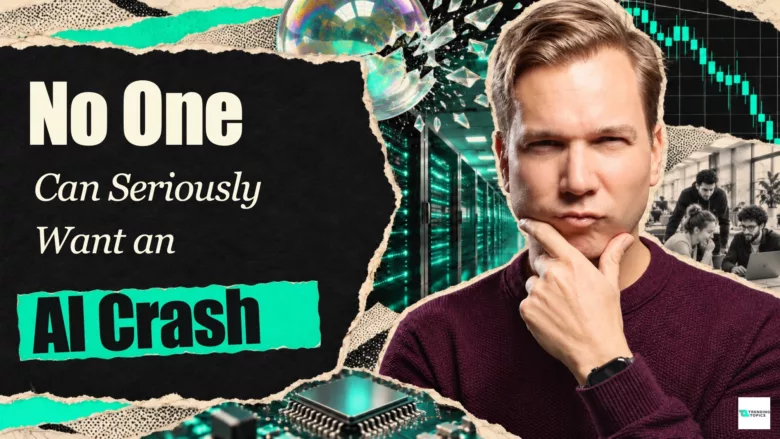
No One Can Seriously Want an A.I. Crash


Set Trending Topics as a preferred source on Google.
The number of people predicting a crash is growing faster right now than the revenue of some A.I. companies. Shares of neoclouds like CoreWeave and Nebius have lost up to 40 percent in a single month, OpenAI has cut its funding round from $30 billion to $20 billion, and Gartner believes four out of five neoclouds will no longer operate independently by 2030. Add to that the opponents of new data centers, who are taking to the barricades in the United States, in Austria and most recently in Finland, where authorities halted work on two Google sites and police are now investigating the company.
Cory Doctorow puts it most bluntly. The Big Tech critic sees A.I. as a business that loses money with every new customer, and in an interview with Trending Topics, he offered Europe some remarkable advice: “If you want AI, wait for the bubble to burst and buy everything at 90 percent off.” He is not alone. In the tech scene, among investors and in politics, many people are longing for the bang, whether out of schadenfreude toward Silicon Valley or in the hope of picking up the remains on the cheap.
I think that is a dangerous wish.
Anthropic’s I.P.O. as a Litmus Test
Whether the mood turns will probably be decided in the coming weeks. Anthropic plans to list on the Nasdaq before Thanksgiving and to raise at least as much as SpaceX did, $86.2 billion. Its numbers are breathtaking and frightening at the same time: In the third quarter, the company brought in about $17 billion in revenue, 12 times as much as a year earlier, but posted a net loss of $23 billion. On top of that come about $895 billion in commitments for computing power. Investors are talking about a valuation of around $1.5 trillion.
Mr. Doctorow fears that retail investors and their retirement savings will become “exit liquidity” for insiders. The risk is real. But if the I.P.O. goes wrong, it will hit far more than Anthropic’s shareholders. The question will then be whether the hundreds of billions spent on data centers will ever pay off, and it will hang over the entire industry at once.
And in the United States, the headwinds for Anthropic, OpenAI and their rivals are getting stronger. After the Democrats’ midterm victory, the industry faces data center construction freezes and tougher rules. In Texas, which accounts for 27 percent of planned U.S. data center capacity, according to Wells Fargo, Gov.-elect Gina Hinojosa has promised a pause on new projects, and the newly elected governors of Georgia and Ohio have called for one as well. Goldman Sachs estimates that such moratoriums could affect about 45 percent of planned expansion. In Congress, Shakeel Hashim, an A.I. policy analyst, considers it likely that strict legislation on the most powerful models, with mandatory testing and approval, will pass in the first months of next year. That could end the self-regulation President Trump has granted the industry so far. For companies whose plans rest on ever more computing power, it is bad news at a bad time.
Without A.I., America Would Be Close to a Recession
The A.I. boom has long been more than a stock market story. “Without the AI boom, we probably would be in a recession,” David Rosenberg, a Canadian economist, said recently. Mr. Doctorow goes further and argues that the U.S. economy outside the big A.I. companies is already in a recession. An analysis by the University of Hawaii reaches a more cautious conclusion, but it is hardly reassuring: Without A.I., U.S. growth would recently have been only about half as strong. The biggest effect comes from stock market gains, which make households richer and encourage them to spend, while investment in data centers has a much weaker impact. If the bubble bursts, that engine stalls.
For Europe, this would not be a distant affair. The United States is the European Union’s most important export market and Austria’s second most important after Germany. An American recession triggered by an A.I. crash would hit machine builders, auto suppliers and pharmaceutical companies on this side of the Atlantic directly, on top of the tariffs President Trump has already imposed.
Europe’s Savings Are in U.S. Stocks
Mr. Doctorow believes a crash would not spread very far because the E.U. “isn’t that exposed.” The numbers tell a different story. According to the U.S. Treasury Department, investors from Europe held $9.6 trillion (about €8.6 trillion) in U.S. stocks in mid-2025, almost half of all foreign holdings. Euro area holdings have quadrupled in 10 years, according to the European Central Bank, driven mainly by the A.I. boom. And in 2025 alone, foreign investors bought a record net $720 billion (about €647 billion) in U.S. stocks.
This is not abstract hedge fund money. Anyone in Europe with an E.T.F. on the MSCI World in a savings plan has about 70 percent of it in U.S. stocks, and the biggest positions are Nvidia, Microsoft, Apple and Alphabet. The E.C.B. puts euro area households’ exposure to U.S. tech stocks alone at about €440 billion, and funds, E.T.F.s, insurers and pension funds add considerably more. In a blog post, its economists drew a clear conclusion: “A US AI fallout would not remain a US problem.” Anyone longing for the crash is also wishing for a slump in their own retirement savings.
Europe’s A.I. Hopes Depend on U.S. Money
The European start-up scene would be hit even more directly. The unicorns Europe is so proud of are largely financed with American capital. Andreessen Horowitz, General Catalyst and Lightspeed sit on Mistral’s cap table, CapitalG and Menlo Ventures on Lovable’s, and Accel, Benchmark, ICONIQ and Fidelity on Legora’s. And Nvidia is in almost all of them: The chipmaker accounts for about 10 percent of all start-up investment in Europe this year.
What happens when Nvidia’s share price is cut in half and U.S. funds have to lick their wounds is something Europe already experienced after the dot-com crash: Venture capitalists pulled back for years, funding rounds collapsed and valuations cratered. This time, Mistral, Lovable and Legora would be caught in the middle of their buildout, and their dependence on American money would hit them first. A crash would set back by years the European A.I. sovereignty that is so often talked about.
The Bargain Theory Has a Catch
That leaves the hope for a great clearance sale. Mr. Doctorow likes to tell the story of the office chairs that cost $1,500 before the dot-com crash and that he bought for $25 afterward. But office chairs barely lose value. A.I. chips, by contrast, become outdated within a few years because Nvidia releases a new generation every year. Anyone buying cheap servers out of a bankruptcy estate in 2028 is buying yesterday’s technology.
Then there is the question of who will be able to buy anything after a crash. It is unlikely to be European start-ups whose investors are licking their wounds, or those that have built their business models on the platforms of OpenAI, Anthropic and others via their A.P.I.s. It will be the companies with deep balance sheets: Microsoft, Google, Amazon and their Chinese rivals. A crash would more likely deepen the concentration that critics like Mr. Doctorow rightly complain about.
A Soft Landing Is the Better Scenario
None of this means the warnings should be ignored. The losses are enormous, the valuations are ambitious and the neoclouds’ debt is dangerously high. A correction will come, perhaps as soon as Anthropic’s I.P.O. But there is a huge difference between a healthy correction and a crash that drags down pensions, exports and Europe’s A.I. scene with it.
Even Mr. Doctorow said in the interview: “I would wish for a soft landing, but the worst thing would be to live through the crash and then do nothing.” He has a point. Europe should use the time to strengthen its own capital markets so that savings and start-up funding depend less on Wall Street. Hoping for the bang is not a strategy.