Uranium Cubes Show Nazi Germany Never Stood a Chance at the Atomic Bomb


Trending Topics auf Google als bevorzugte Nachrichtenquelle festlegen.
Hitler’s nuclear scientists did not narrowly miss a breakthrough; they were miles away from one. That is the conclusion of a new study just published in the journal PNAS Nexus. A team led by physicist Patrick Park of Columbia University used the methods of so-called nuclear archaeology to recalculate the final reactor experiment of the Nazi uranium project. Their verdict is unambiguous: „Our findings indicate that Germany could not have built either a heavy water nor a graphite reactor in World War II.“ Researchers from the University of Maryland, Pacific Northwest National Laboratory, Texas A&M University and Johns Hopkins University were also involved. The magazine Science was the first to report on the study.
The Last Experiment in the Rock Cellar
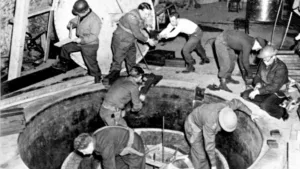
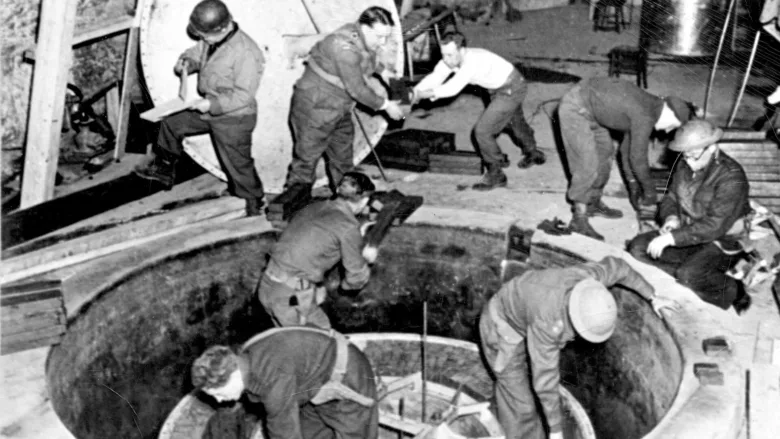
The study focuses on the B8 experimental reactor, which Werner Heisenberg and his team assembled in April 1945 in a rock cellar in the Swabian town of Haigerloch. It consisted of 664 uranium cubes hanging on chains in heavy water, surrounded by a graphite jacket. The goal was a self-sustaining chain reaction, something Enrico Fermi’s team in Chicago had already achieved in December 1942. Shortly afterward, Allied troops entered Haigerloch and seized the material.
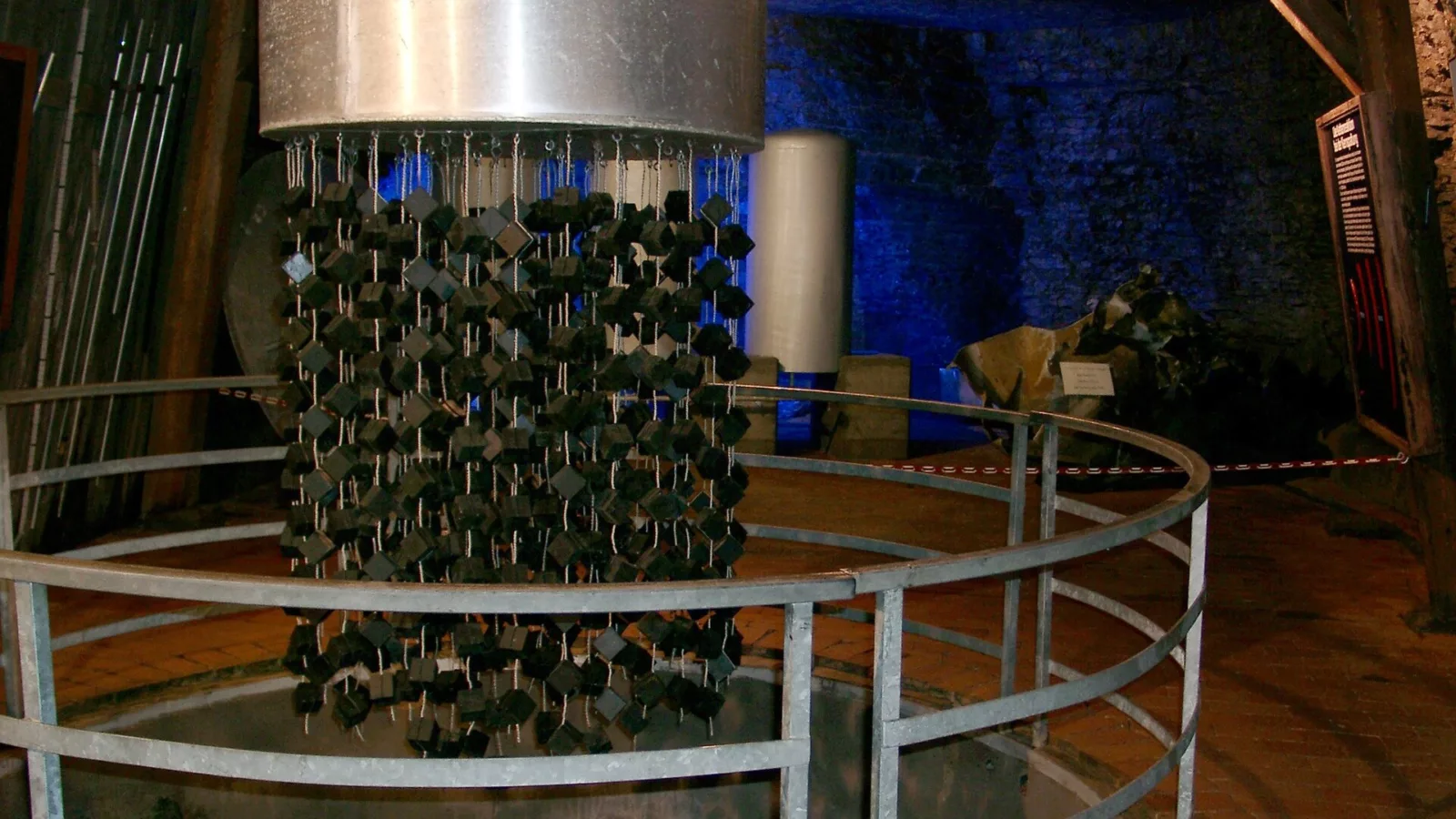
After the war, Heisenberg portrayed the result as a near miss. In a 1947 article in the journal Nature, he wrote that the B8 had been „just insufficient“ to achieve self-sustaining fission, lacking only a „relatively small amount of uranium.“ In the decades that followed, historians also argued that the Germans should have pursued graphite reactors like the Americans. Until now, neither claim could be verified.
Twice the Uranium and Heavy Water
The researchers conducted a forensic examination of the B8’s uranium, heavy water and graphite and analyzed historical documents. From this, they built a neutronics model of the reactor, which they validated against measurements taken at the experiment itself in 1945. The results:
- Neutron balance: The B8 reached a multiplication factor of 0.94. A chain reaction requires at least 1.0. In other words, the reactor produced only about 94 percent of the neutrons needed.
- Uranium: A critical reactor would have required about twice as much uranium, roughly 3.1 metric tons instead of the 1.54 tons used.
- Heavy water: About 2.2 times as much would have been needed, roughly 3,100 liters instead of about 1,400 liters.
- Inventories: Both amounts were well above what Germany is estimated to have had available during the war, by a factor of 1.2 for uranium and 1.8 for heavy water. The requirements were thus „far exceeding Heisenberg’s predictions,“ the study’s abstract says.
- Graphite: The graphite had been reused from the earlier B7 experiment and contained 3.4 parts per million of boron, which absorbs neutrons. Even a hypothetical reactor made of graphite and natural uranium could not have gone critical with it.
The root of the graphite problem was the raw material. German graphite was made from metallurgical coke, which naturally contains more boron than graphite based on petroleum coke. The latter was available in the United States and was what made it possible for the first reactor, Chicago Pile 1, to go critical, the researchers write.
That left Germany with no realistic path to a working reactor. Without a working reactor there was no plutonium, and without plutonium or large amounts of enriched uranium, there was no bomb. In hindsight, Heisenberg made the gap to success look much smaller than it was.
The Myth of Hitler’s Bomb
The question of how close Nazi Germany came to the atomic bomb has occupied historians for decades. Fear of a German bomb was a major driving force behind the American Manhattan Project. Ironically, an Austrian also helped lay the theoretical groundwork: The Vienna-born physicist Lise Meitner, together with Otto Frisch, provided the explanation in 1938 for nuclear fission, which Otto Hahn and Fritz Strassmann had discovered in Berlin.
Not everyone agrees that the Germans were far from their goal. In his 2005 book „Hitler’s Bomb,“ the historian Rainer Karlsch argued that German scientists led by Kurt Diebner had tested a nuclear explosive device in Thuringia in 1945. That account is disputed among experts. The new study concerns Heisenberg’s project and its reactor experiment, not the rival group around Diebner.
The surviving uranium cubes themselves are now scattered around the world. Some ended up in the United States after the war, where researchers such as Timothy Koeth of the University of Maryland have spent years reconstructing their origins. In the former rock cellar in Haigerloch, a museum now commemorates the final experiment of the Nazi uranium project.