ASML Can’t Build Machines Fast Enough for the A.I. Boom


Trending Topics auf Google als bevorzugte Nachrichtenquelle festlegen.
If you want to know how long the A.I. boom will last, Veldhoven is a good place to look: Customers of ASML are already asking to order machines for 2029 and 2030. The Dutch chip equipment maker just reported its results for the third quarter of 2026, with record revenue of €11.7 billion (about $13.4 billion). The more important signal lies in the outlook: According to Christophe Fouquet, the chief executive, planned production capacity for 2027 and 2028 will not be enough to meet demand.
The Numbers at a Glance
- Revenue: €11.7 billion, up about 55 percent from the same quarter a year earlier (€7.5 billion) and 25 percent more than in the second quarter
- Net income: €5.0 billion, more than double the figure a year ago (€2.1 billion)
- Gross margin: 57.5 percent, up from 54.0 percent in the previous quarter
- Systems sold: 113 new lithography machines, up from 86 in the previous quarter
- Service business: €3.3 billion in revenue from maintenance and upgrades of installed machines
- Fourth-quarter outlook: revenue of €14.2 billion to €15.2 billion, with a gross margin of about 57 percent
- Full-year outlook: revenue of €44 billion to €45 billion, with the lower end raised from €43 billion. In 2025, ASML had revenue of €32.7 billion
ASML is using its profits to buy back a lot of its own stock: About €4.1 billion in the third quarter alone. It also declared an interim dividend of €1.88 per share. The stock rose more than 2 percent in Amsterdam after the results and is up about 60 percent since the start of the year.
Why ASML Matters
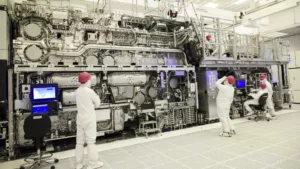
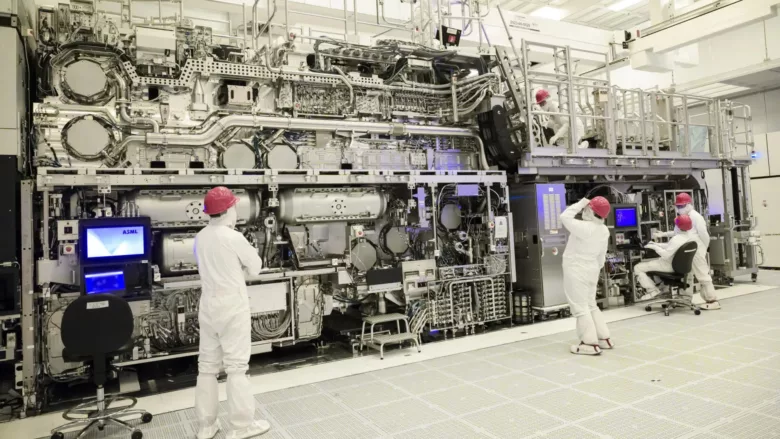
ASML is the only company in the world that builds EUV lithography machines. These systems use extreme ultraviolet light to print tiny structures onto silicon wafers, and the most advanced chips cannot be made without them: Neither Nvidia’s A.I. accelerators, which TSMC manufactures in Taiwan, nor the high-bandwidth memory from SK Hynix and Samsung that sits in every A.I. data center. A single machine costs well over €100 million depending on the model, and the latest High-NA generation costs several hundred million. Because ASML depends on a network of highly specialized suppliers such as Zeiss (optics) and Trumpf (lasers), production cannot simply be ramped up at will. That makes the company a bottleneck for the entire A.I. industry, as well as Europe’s most valuable tech company.
What the Numbers Say About the A.I. Industry
ASML is considered a leading indicator for the chip industry, because its machines are ordered one to two years before actual chip production begins. When chipmakers are already talking about deliveries for 2029 and 2030, they are evidently planning for an A.I. build-out that will last for years. Customers’ forecasts are “driven primarily by their views on the size and duration of A.I.-related investments,” Mr. Fouquet said.
ASML is responding with a major expansion. In 2027, capacity for current-generation EUV machines and DUV immersion systems is set to increase by 30 percent. For 2028, the company is already examining whether it can go beyond the additional 30 percent it had previously targeted. Fears of an A.I. slowdown have repeatedly weighed on chip stocks this year. The ASML figures point the other way, much like Nvidia’s recent quarterly results.
China Risk and Skeptical Voices
China remains a risk: ASML expects the country to account for about a fifth of its revenue in 2026, and lawmakers in Washington are considering the so-called Match Act, a bill that would ban sales of DUV machines to China and even the servicing of systems already installed there. Mr. Fouquet warned that overly broad export restrictions would only push China to develop its own alternatives faster.
Analysts have reservations, too. The investment bank Jefferies called the higher capacity plans for 2027 and 2028 “broadly expected” and expects the valuation multiples of ASML and the sector as a whole to contract further, limiting the stock’s upside. And interest in orders for 2029 and 2030 is still not the same as firm orders, while the memory business in particular is known to be highly cyclical.
The Competition
In EUV, ASML stands alone. In older DUV machines, it competes with the Japanese manufacturers Nikon and Canon, with Canon also betting on an alternative nanoimprint technology. In China, SMEE and Huawei are working on their own lithography systems but are still years behind technologically. Applied Materials, Lam Research and KLA rank alongside ASML among the major chip equipment makers, although they supply other steps of chip production, such as deposition, etching and inspection.