Nvidia’s First Earnings Without Huang: Wall Street Expects $109 Billion in Revenue


Set Trending Topics as a preferred source on Google.
The numbers will probably shine again, but this time the real question is who presents them: Nvidia reports its first quarterly results without Jensen Huang after the U.S. market closes today.
The co-founder resigned as chief executive last week after 33 years at the helm, following reports of multiple affairs, including one with a former executive of the Singapore data center operator Megaspeed whom U.S. intelligence officials suspect of being a Chinese intelligence asset. Chief Financial Officer Colette Kress is running Nvidia on an interim basis, and the board has ordered an independent investigation into whether Mr. Huang was the target of a spy operation. Despite a petition and support from President Trump, a return by Mr. Huang is not on the table, as Trending Topics reported. Treasury Secretary Scott Bessent has also given Nvidia a 10-day ultimatum to explain its China chip sales.
The crisis has left deep marks on the stock market. On Monday, Nvidia’s shares closed down 4.12 percent at $156.14 (about €140), according to The Washington Post. Its record closing high in early October, weeks before the first reports about Mr. Huang’s affairs, was $239.24 (about €215), meaning the stock has lost about 35 percent since. The fallout is dragging down the whole sector: The chipmakers Micron and Intel each fell more than 7 percent on Monday, the Nasdaq Composite lost 2.49 percent, the S&P 500 1.92 percent and the Dow Jones Industrial Average 1.41 percent.
What Wall Street Expects
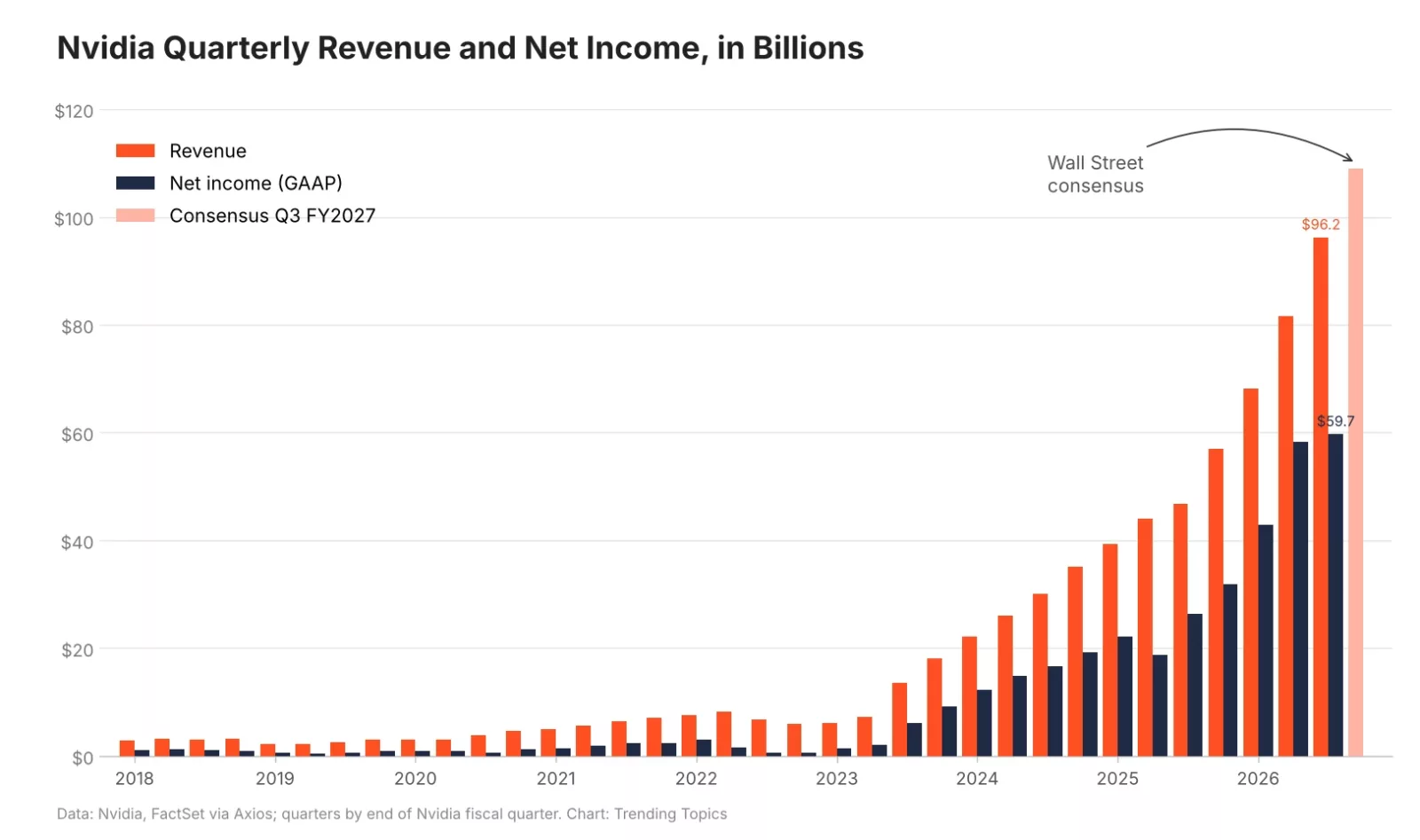
Few doubt the raw numbers. Analysts expect revenue of about $109 billion (about €98 billion) for the third quarter of fiscal 2027, according to FactSet data cited by Axios. Nvidia itself had guided for $108 billion, plus or minus 2 percent. These are the figures to watch:
- Data centers: Revenue from data center chips is expected to nearly double to about $101.9 billion (about €91 billion).
- Outlook: Wall Street expects revenue guidance of $125.2 billion (about €112 billion) for the current quarter.
- Full-year forecast: Last quarter, Nvidia offered full-year sales guidance for the first time ever, targeting about 70 percent revenue growth for fiscal 2028. Any change to that figure is likely to move the stock sharply.
For comparison, Nvidia posted revenue of $96.2 billion and net income of $59.7 billion (about €86 billion and €54 billion) in the second quarter, according to its own release. In the spring of 2023, shortly after ChatGPT’s launch, quarterly revenue stood at about $7 billion and profit at $2 billion.
Will Kress Stick With Huang’s Deals?
Nvidia sells the world’s most sought-after A.I. chips, and it also finances a good part of the industry. The company buys stakes, co-invests and backstops debt for companies ranging from neoclouds like CoreWeave to the fiber-optic provider Lumentum. It is providing a backstop for an OpenAI data center in Ohio, and according to Anthropic’s prospectus, Nvidia plans to invest about $10 billion (about €9 billion) in the company, which lists on the Nasdaq this week.
Critics call such deals circular financing: Nvidia gives customers money that flows back as chip revenue. Mr. Huang was able to push this strategy as co-founder and sole C.E.O. Investors will therefore listen closely on the conference call for signs of whether Ms. Kress continues the course or pulls back.
Export Rules Could Cost Revenue
Several banks warn that the circumstances of Mr. Huang’s exit could reshape Nvidia’s global business. On Monday, the U.S. government issued a new export rule for data centers that makes it harder for Chinese companies to access A.I. chips remotely and puts Malaysia, Singapore and other countries on a short leash. Here is what analysts said, according to Axios:
- UBS: Its biggest concern is new scrutiny of sales into countries such as Singapore and Malaysia. In a worst case, that could cut up to about 10 percent of revenue.
- BofA Securities: Greater scrutiny of Asian shipments that indirectly serve Chinese customers via the cloud, or more conservative funding of emerging U.S. neocloud customers, could cost market share.
- HSBC: The bank downgraded the stock to “hold” from “buy” last week. Over the past six quarters, 11 percent of revenue came from countries other than the United States and Taiwan, which HSBC believes could become the focus of new restrictions.
Competition is adding pressure, too, from AMD and Google’s in-house TPU chips. Anthropic has just told its future shareholders that its A.I. ported a Claude model to AMD chips in three days, chipping away at Nvidia’s most important moat, its CUDA software. If the report falls short of expectations, the already shaky A.I. trade is likely to take another hit.