BYD Sells More EVs in a Month Than the Entire U.S. Does in a Quarter

Trending Topics auf Google als bevorzugte Nachrichtenquelle festlegen.
What the United States registers in electric cars in three months, BYD sells in one.
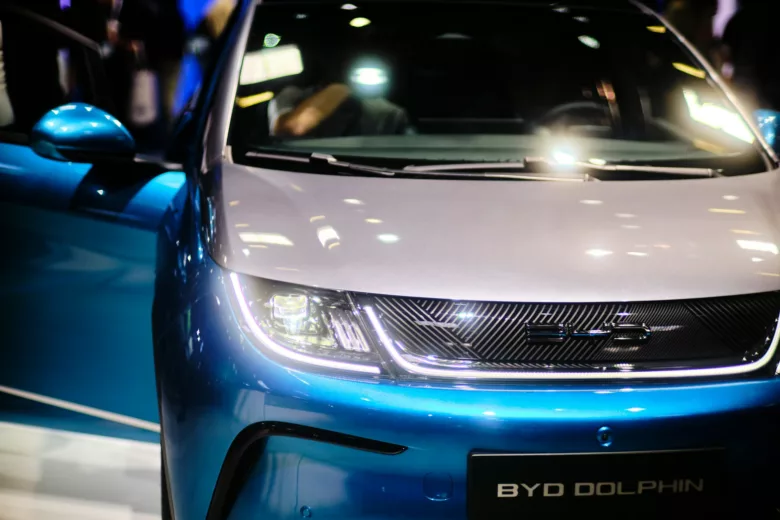
The Chinese automaker sold 305,743 purely battery-electric passenger cars in October, according to CnEVPost, up 37 percent year over year and the first time it has passed 300,000 in a month. For comparison: In the entire third quarter, about 262,500 EVs were sold in the United States, according to Kelley Blue Book, and that was the country’s best quarter of the year. Including plug-in hybrids, BYD reached 490,168 vehicles in October, 11 percent more than a year earlier and its strongest month of 2026. Pure EVs now account for 63 percent of sales, up from half a year ago.
Exports Doubled, Home Market Shrinking
Behind the record is a shift that matters more to Europe than the headline number. In China itself, BYD sold just under 320,000 vehicles in October, about 11 percent fewer than a year earlier, and domestic sales are down 28 percent since the start of the year. The price war with dozens of budget brands and the expiry of government purchase incentives are weighing on demand. BYD is making up for it abroad: 170,194 vehicles were exported in October, more than twice as many as a year ago, and more than 1.5 million since January. For the full year, the company is aiming for about 2 million overseas sales, according to Electrek, rising to more than 2.5 million in 2027. On balance, after ten months BYD stands at 3.62 million vehicles, just under 2 percent below last year, with plug-in hybrids losing ground and pure EVs growing.
The weak home market is also why the number is alarming for the rest of the world: The overcapacity that has built up in China has to go somewhere. The company has started building its own charging network with flash chargers in Germany, and it is building its first European plant in Szeged, Hungary, which, after delays, is due to begin series production at the end of the year. That lets BYD sidestep the E.U.’s additional tariffs on EVs built in China, in force since 2024. So far, the company has responded to the tariffs mainly with plug-in hybrids, which are not covered: In the first half of the year, BYD reached 174,144 registrations in Europe, according to industry data, and a market share of 2.4 percent, level with Tesla, which had been well ahead a year earlier, though with a sizable hybrid share.
Why the U.S. Is So Far Behind
That a single manufacturer overtakes the entire U.S. market in a month has two causes. One is China: More than half of all EVs sold worldwide are sold there, and BYD is the market leader with a vertical integration from battery cell to semiconductor that no Western manufacturer matches. The other is the United States itself: The market is small, with an EV share below 10 percent, the $7,500 federal tax credit is gone, and Chinese cars are effectively locked out by 100 percent tariffs. BYD does not sell a single car in the United States and still draws the comparison, because it shows the scale.
The counterargument comes from the numbers themselves: BYD’s total sales are flat, the growth comes from exports, and export markets can be closed with tariffs, localization requirements and security concerns. The E.U. is already examining how to respond to Chinese plants in Europe with minimum prices or technology-transfer conditions, and the factory going up in Hungary is one whose value creation will initially come largely from China. Whether BYD grows in Europe the way it has in Southeast Asia or Latin America will be decided less in Shenzhen than in Brussels.