The Great Pacific Garbage Patch May Be Changing the Color of the Ocean

Trending Topics auf Google als bevorzugte Nachrichtenquelle festlegen.
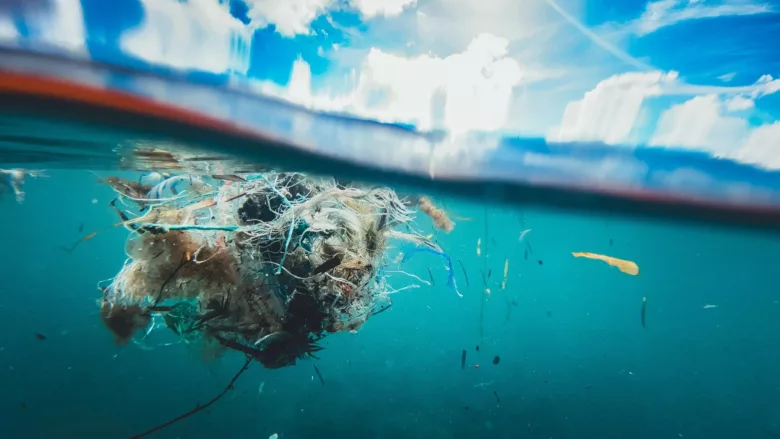
The world’s largest floating trash heap appears to be leaving a mark visible from space: Over the past 20 years, the water around the Great Pacific Garbage Patch has become measurably brighter and taken on a faint cyan tint. That is the finding of a new study by researchers at the University of Bergen in Norway, published this week in the journal Communications Earth & Environment. The most likely culprit, they say, is microplastics.
What the Satellites Show
The team, led by Daniel Koestner, a postdoctoral researcher, and Shea Cheatham, a Ph.D. student, analyzed satellite data from 2002 to 2022. In and around the garbage patch, the ocean reflects significantly more light in the blue and green wavelengths than the surrounding waters, and that difference has grown over time. To the human eye, the water would look slightly brighter and more turquoise.
„Our first reaction was disbelief,“ Ms. Cheatham told ScienceAlert. The researchers were „shocked, excited, and a little alarmed,“ she said, when the same color shift they had seen in the lab showed up on the map.
The Great Pacific Garbage Patch lies between Hawaii and California. According to the nonprofit The Ocean Cleanup, it covers about 1.6 million square kilometers (roughly 620,000 square miles), about twice the size of Texas. A 2018 survey counted about 1.8 trillion pieces of plastic weighing some 79,000 metric tons. Microplastics make up about 94 percent of the pieces but only about 8 percent of the mass.
Plastic Smoothies in the Lab
The researchers got onto the trail through lab experiments. Mr. Koestner blended plastic waste into what he called „smoothies“ and used lights and lasers to study how the particles scatter light. Plastics like polystyrene, polypropylene and polyester absorb very little visible light but scatter it strongly, more strongly than organic material such as algae. That signature, more reflected blue and green, is exactly what the team then found in the satellite data.
In simulations, the researchers also tested natural explanations, such as more or different types of phytoplankton. Only when microplastics were added to the model did the likelihood of the observed color rise sharply. „We were able to say that we have this specific spectrum of light, this color that microplastics tend to produce,“ Ms. Cheatham told CNN.
Why It Matters
Microplastics are among the most stubborn environmental problems there are. The tiny particles harm microbes, change the behavior of fish and accumulate in seafood that ends up on our plates. Researchers also expect a dramatic rise in microplastics in the environment by 2060. At the same time, scientists know surprisingly little about where ocean plastic actually ends up. Of the up to 13 million metric tons of plastic that enter the oceans each year, only a fraction floats at the surface. Much of it probably sinks to the seafloor, where, according to an earlier estimate, up to 11 million metric tons of plastic waste may have accumulated.
So far, measuring microplastics has been painstaking: Ships collect water samples that are then analyzed in the lab. „We don’t really have a good way of quantifying or measuring these really small microplastic particles without laborious methods,“ Mr. Koestner told CNN. If the color method holds up, pollution could one day be tracked by satellite across entire oceans. For Mr. Koestner, that would have a practical payoff: „That would mean that we have a target area for cleaning up,“ he told Scientific American.
Who Wants to Clean Up the Ocean
Cleaning up is easier said than done. The Dutch nonprofit The Ocean Cleanup aims to remove the world’s largest garbage patch by towing huge collection systems through the Pacific. The E.U.-funded SeaClear project relies on robots that clear trash from the seafloor. And NASA is already working on tracking ocean plastic by satellite, though with a different approach that infers microplastics from the roughness of the ocean surface. When it comes to microplastics, however, every method runs into limits. Removing the smallest particles from the sea is „essentially impossible,“ Ms. Cheatham said. For now, the only remedy is to keep them out of the water in the first place.
The Proof Is Still Missing
The researchers themselves stress that their finding is not yet proof. „We’re still one step away from proving definitively“ that plastics are the cause, Ms. Cheatham told Scientific American. „We just have to get in there to verify.“ That means traveling to the garbage patch to take optical measurements of water samples, a tricky and expensive undertaking. The team would need to show that the color is caused directly and exclusively by plastics.
Other factors can also change the color of the ocean. Phytoplankton absorb blue and red light and turn the water greener, dissolved organic matter makes it look darker, and mineral dust can brighten it. According to ScienceAlert, the researchers found no change in dust deposition over the study period, though certain combinations of natural changes could produce a similar signature. Climate change is also shifting the color of the oceans worldwide. Richard Thompson, a marine biologist at the University of Plymouth in England who was not involved in the study, told CNN that „detecting a plastic related signal is very challenging,“ because microplastics are tiny and mixed in with phytoplankton and natural debris. But if changes can be detected remotely from satellites, he said, „it will be faster and less costly than counting debris piece by piece.“