DeepSeek and Moonshot Reportedly Copied OpenAI’s GPT-6 Astra


Trending Topics auf Google als bevorzugte Nachrichtenquelle festlegen.
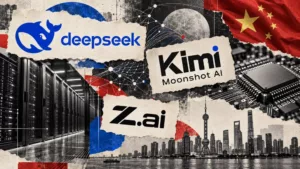
When Claude shuts the door, GPT-6 becomes the next target. According to a report by The Information, the Chinese A.I. start-ups DeepSeek and Moonshot AI trained their latest models on large volumes of output from OpenAI’s top model, GPT-6 Astra. The shift reportedly came after Anthropic sealed off its Claude models against this kind of access.
What The Information Reported
According to The Information’s report, which cites people with direct knowledge of the matter, GPT-6 Astra has become the main target of Chinese A.I. labs for so-called distillation. The technique involves sending large numbers of prompts to a more capable model and using its answers as training data for one’s own model. This makes it possible to adopt capabilities without investing the same effort to build them from scratch.
Two current models are said to have benefited heavily: Moonshot AI’s Kimi K3.1 Pro, unveiled last week, and an updated version of DeepSeek’s V4.1-Flash, available since mid-October. According to Reuters, OpenAI, DeepSeek and Moonshot did not immediately comment on the report.
The accusations against Moonshot are not new for OpenAI either. In late September, OpenAI said in a blog post that it had stopped a coordinated campaign that tried in July to extract the hidden reasoning of its models. According to OpenAI, more than 15,000 user accounts were involved, and the company linked the core of the campaign to people associated with Moonshot.
Anthropic Raised Accusations Earlier
Anthropic was the first to go public, however. In February, the company accused DeepSeek, Moonshot AI and MiniMax of sending more than 16 million requests to Claude through more than 24,000 fraudulent accounts in order to train their own models. In September, Anthropic followed up in its Threat Intelligence Report, naming seven Chinese labs:
- Alibaba: about 151 million requests, which Anthropic called the largest distillation attack it had ever measured
- Moonshot AI: about 23 million requests, partly through customer queries that were allegedly routed to Claude instead of Kimi without users knowing
- DeepSeek: more than 12 million requests within 14 days
- Others: Zhipu, Xiaomi, SenseTime and MiniMax
Anthropic then stepped up its defenses, including stricter identity checks and changes to how Claude outputs its reasoning. In mid-October, the company said these measures had reduced the amount of data harvested through distillation by 90 to 99 percent. If The Information’s report is accurate, the labs then turned to OpenAI.
Where the Models Rank
The Intelligence Index from Artificial Analysis shows how capable the models in question are. In the recently released Version 5 of the index, which relies mostly on private test data, the picture looks like this:
- Claude Opus 5.5 (Anthropic): 58 points, first place
- GPT-6 Astra (OpenAI): 57 points, second place
- Kimi K3.1 Pro (Moonshot AI): 46 points, the best model with open weights, although Moonshot has not yet released them
- DeepSeek V4.1 Flash: 32 points
Both Chinese models dropped sharply in the new index. Kimi K3.1 Pro scored 55 points in the previous version, ranking fourth and ahead of GPT-6 Astra. DeepSeek V4.1 Flash fell from 45 to 32 points.
Who Is Taking What From Whom
The accusations are politically charged. U.S. authorities cite distillation, among other reasons, to justify restrictions on Chinese A.I. companies, and the U.S. government has already banned DeepSeek from federal agencies. Beijing rejects the accusations and has threatened countermeasures. At the launch of Kimi K3.1 Pro, Moonshot had also stressed that the model outperformed GPT-6 Astra on a coding benchmark.
Critics also point out that U.S. labs trained their own models on other people’s content without asking first. OpenAI is being sued by The New York Times, among others, for copyright infringement, and Anthropic agreed last year to a $1.5 billion settlement with book authors. The distillation accusations themselves are so far based on statements from the U.S. companies involved and anonymous sources and have not been independently verified.