Erste Group Joins Poland’s 680 Million Euro Fund of Funds

Trending Topics auf Google als bevorzugte Nachrichtenquelle festlegen.
Erste Group and Erste Bank Polska announced a joint investment on Thursday in the Innovate PL Fund of Funds, the centerpiece of the „Innovate Poland“ initiative that has been running under the patronage of Poland’s finance ministry since November 2025. By joining at the fund’s second closing, the two institutions become the first private, listed banks to invest in the vehicle. Erste Group does not disclose how much it is committing, only the fund’s target: with Erste and other investors on board, it is set to reach total commitments of almost 3 billion zloty, roughly 680 million euros.
How the Polish Fund of Funds Works
The Innovate PL FoF does not invest directly in companies but in around 20 professionally managed private equity, private debt and venture capital funds, with a target allocation of 60, 20 and 20 percent. It is managed by PFR Ventures, the investment arm of the Polish Development Fund, and backed by the Polish development bank BGK and the European Investment Fund (EIF). A second vehicle, Future Tech Poland, runs in parallel, jointly managed by EIF and BGK and aimed at venture funds investing in seed to Series B rounds. Together, the two pools are meant to supply Polish companies with capital from tech startups to mid-sized firms on an expansion course, at market terms and targeting market returns. Erste’s investment is therefore not a subsidy but an asset.
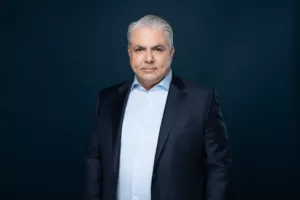
„If Europe wants more champions, we have to create the conditions for their growth,“ says Erste Group CEO Peter Bosek. „Poland has the talent, the ambition and the economic strength to produce more companies that can establish themselves successfully on the international stage.“ Michał Gajewski, CEO of Erste Bank Polska, adds that the investment shows „that Poland is a strategic market for the group and that it has long-term plans for the country.“
Why Bosek Is Doing So Much in Poland
The plans are more than long term; they are the biggest bet in the company’s history. In January, Erste Group completed the acquisition of 49 percent of Santander Bank Polska and 50 percent of its fund management company for around 7 billion euros, the largest foreign transaction the bank has ever made, financed without a capital increase. The bank, Poland’s third largest with a market share of over 8 percent, has recently been operating as Erste Bank Polska. Bosek, at the helm of Erste since 2024, justified the deal with the logic that Poland is Europe’s most important growth market: 38 million inhabitants, years of growth rates Austria can only dream of, a banking market still underpenetrated compared with Western Europe, and an economy investing massively in defense, energy and infrastructure because of its position on NATO’s eastern flank. With eight banks in Austria, the Czech Republic, Slovakia, Romania, Hungary, Croatia and Serbia, Erste was already Central Europe’s leading banking group; Poland was the big gap on the map.
The fund investment is the logical continuation: whoever declares a country a core market also has to finance its companies, not just with loans but with equity for those firms banks traditionally cannot finance. „With our participation in Innovate Poland, we are helping to improve financing opportunities for innovative companies and pave their way to international scale,“ Bosek says. „At the same time, we are underlining our ambition to be a long-term partner for growth and economic success in Poland and Central Europe.“ That the Polish government provides a ready-made, state-anchored framework with PFR, BGK and EIF that private investors merely need to join makes the decision easy. For Erste, it is also a signal to Warsaw, where the takeover of one of the country’s largest banks by a foreign group was not met with enthusiasm alone.
Status Quo in Austria: 23 Million Euros Through 2029
Erste Group has thus done in Poland what it cannot yet do in Austria. The domestic fund of funds, demanded by the startup scene for years and approved by the council of ministers in September 2025, is not due to become operational until early 2027, according to the government’s industrial strategy. A concept paper from the office of State Secretary Elisabeth Zehetner, obtained by Trending Topics, shows the current state of play: a target volume of around 500 million euros, the federal government as anchor investor with up to 100 million euros, implemented via the aws, which is tendering the management internationally. However, only 23.23 million euros are budgeted in the current legislative period through 2029; the remaining roughly 77 million are to flow between 2030 and 2042, largely from returns on existing aws holdings and the fund itself. Details are still being coordinated with the finance ministry, and a binding commitment for the full 100 million is a precondition for launch.
The parallels with Poland are obvious, and so are the differences. Both models are funds of funds with a public anchor and private investors, both target pension funds, insurers and banks as backers. Poland set up its fund within a year, with a development bank, sovereign fund and EIF as its backbone and almost 680 million euros as its target; Austria has been debating since 2023 and still has no manager. Whether Erste Group, which together with the savings bank group ranks among the country’s largest institutional investors, will also come on board as an anchor investor in Vienna is something it has not yet said.