XREAL AURA: First Android XR Glasses Launch, but Not in Europe

Trending Topics auf Google als bevorzugte Nachrichtenquelle festlegen.
Google is putting its Android XR operating system into a pair of glasses for the first time, and Europe, of all places, has to wait outside.
Together with Chinese manufacturer XREAL, Google has just launched XREAL AURA at the Android Developer Summit, which Google calls the first wired XR glasses powered by Android XR. It is the first Android XR device in glasses form, after Samsung brought the Galaxy XR headset running the system to market a year ago. The two companies had teased the glasses at the Google I/O developer conference in the spring. Adults aged 18 and over can order them now in the US, Canada and South Korea, and from November 2 in Japan. The launch price is $1,099 (about €980), with shipments starting in mid-November. Google’s announcement makes no mention of a launch in the EU. XREAL itself states in the FAQ of its European shop that launch and shipping dates for other regions are still to be confirmed. The timing is no coincidence: In Europe, the backlash against camera glasses is growing by the week.
Transparent Lenses, Computer on a Cable
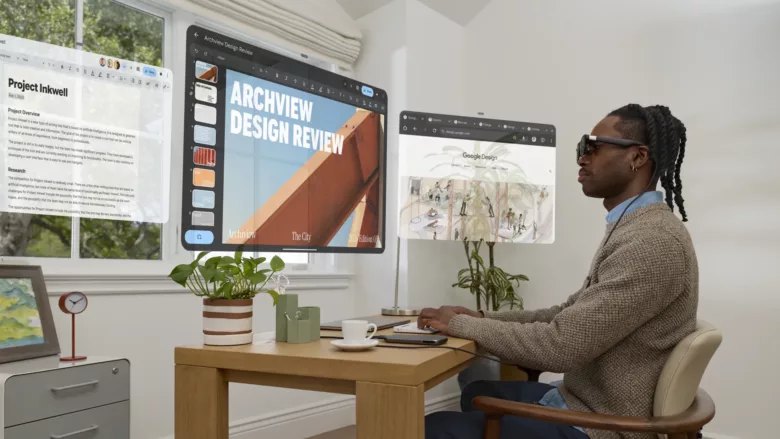
As with Android smartphones, Google is relying on partners for XR: Alongside Samsung, XREAL is the second major hardware partner for Android XR, while Google’s own glasses with Warby Parker and Gentle Monster have been announced but have yet to reach the market. XREAL has been selling display glasses such as the Air and the One for years, but so far without Google’s operating system. AURA is not a pair of smart glasses in the style of the Ray-Ban Meta, which looks like ordinary sunglasses, but it is also not a bulky headset like Apple’s Vision Pro. It is a pair of augmented reality glasses with transparent lenses that project virtual windows into the field of view, with a 70-degree field of view, Sony Micro-OLED displays at 1920 by 1200 pixels per eye, up to 120 Hz and 1,050 nits peak brightness. The lenses can be dimmed electrochromically in five steps. On paper, that beats the Ray-Ban Meta Display, Meta’s glasses with a built-in screen. On the other hand, AURA is noticeably heavier at 95 grams than Meta’s 69 grams, because the computing power is offloaded to a separate puck that connects by cable and adds 265 grams to your pocket. The puck holds a 4,455 mAh battery and Qualcomm’s new Snapdragon Reality Elite chip with 48 TOPS of AI performance, which makes its debut with AURA. The glasses themselves house XREAL’s own X1S coprocessor, which is meant to push motion-to-photon latency down to 3 milliseconds. The puck doubles as a trackpad and has a fingerprint sensor, while the sound comes from Bose-tuned technology with four microphones and open-ear speakers.
Google’s AI assistant Gemini is deeply integrated. It is meant to understand what users are seeing and doing, in the real world as well as on the virtual screens. Those who share their view can have Gemini highlight things in the room or on the screen. That requires cameras: According to the spec sheet, AURA has a high-resolution RGB camera with a privacy LED as well as tracking cameras for spatial and hand recognition. It is exactly these kinds of cameras that are causing debate in Europe.
Work, Watch, Play
Google positions AURA as a mobile workstation, private cinema and game console in one. Several Android apps can be opened at the same time and arranged freely in space, and with a Bluetooth keyboard and mouse, this becomes a desktop setup on the couch or on a plane. A laptop can also be connected via USB-C, with its screen then appearing as a freely placeable window, without additional software. Because only the wearer sees the image, Google advertises the ability to open confidential documents in public.
For entertainment, there is YouTube, Google TV and streaming services, plus 180- and 360-degree videos and 3D movies. The lenses can be dimmed and become transparent again as soon as someone enters the field of view. Specially produced XR content arrives at launch, such as the documentary „Galapagos: the Last Eden“ narrated by Margot Robbie and the San Francisco Ballet’s „Nutcracker.“ For games, Google relies on the Google Play catalog, streaming from PC or console, and new XR titles such as „Fallout Factions“ and „Project Hail Mary: Journey Among the Stars.“ There are also dedicated XR apps from the NBA and NASCAR. In total, more than 150 apps built specifically for XR are expected to be available.
What AURA Costs
The entry-level version with 12 GB of RAM and 256 GB of storage costs $1,099 (about €980) through the end of the year, then $1,279 (about €1,140). The variant with 16 GB and 512 GB of storage is $1,299 (about €1,160) at launch instead of $1,499 (about €1,330). That puts AURA far above Meta’s AI glasses, which start at around $300, but well below Apple’s Vision Pro. Accessories such as a GameSir gamepad with a dedicated Gemini key and a wireless keyboard are extra. In XREAL’s own European shop, AURA can already be placed as a pre-order with full payment up front, in sizes M and L depending on pupillary distance, but the shop lists no euro price and no delivery date. Shipping is „expected before the holidays,“ subject to production and logistics. An independent European retailer lists the 512 GB version at €1,569 but notes that prices for the region have yet to be confirmed.
The high prices also have to do with the economics of the industry. XREAL CEO Chi Xu told TechCrunch in the spring that building a smart glasses business is hard and that everyone is currently losing money. But the industry has reached an inflection point, he said: „You need all the key pieces ready — you need the hardware ready, the operating system needs to be ready, and then you need a great user interface.“ With AURA, he sees that combination in place for the first time.
Europe: The Backlash Is Growing
Google skipping Europe at launch fits a picture that has been taking shape since the summer. Just two weeks ago, the European Data Protection Board (EDPB) published its own statement on smart glasses. In it, the data protection authorities demand, among other things, that recording must not be possible when the recording light is covered, that data should be processed on the device where possible, and that manufacturers and AI providers must not pass their GDPR obligations on to wearers. The statement is not binding but is likely to become the benchmark for national authorities.
Individual countries are going further. Norway wants to temporarily ban AI glasses in public places such as parks, schools and gyms, and the city of Oslo has already banned them in schools. In the Netherlands, parliament is calling for further restrictions, and the optician chain Hans Anders has pulled the Ray-Ban Meta from its range. In Hamburg, the city parliament has approved a ban in swimming pools, saunas and public transport. On top of that, apps such as ZuckOff detect camera glasses nearby. Meta has responded to the criticism with the Ray-Ban Meta Audio, a pair of AI glasses without a camera.
Google has not commented on why AURA is not launching in the EU. Besides data protection, the usual reasons are likely to play a role: New Google hardware regularly arrives in the US first, and then there are certifications, retail networks and the fact that Gemini features also tend to launch late in the EU.
Not Every Pair of XR Glasses Is a Spy Camera
There are, however, a few arguments against lumping AURA in with Meta’s Ray-Ban glasses. With its cable and puck, AURA is hard to wear inconspicuously and is primarily a display for work and entertainment, not a pair of glasses you put on at the bar. Google also stresses that the lenses turn transparent as soon as someone enters the field of view and that the image is visible only to the wearer. Opponents of blanket bans also point to legitimate uses, such as for visually impaired people who have their surroundings described to them, and to the fact that existing data protection laws already cover covert filming. Whether and when Europeans will be able to buy AURA remains open for now. Google’s partnership with Warby Parker for everyday Android XR glasses shows, however, that AURA is meant to be only the beginning.